Monday, March 27, 2017

"Well-Rotted Manure, Steaming"

There is a 1978 watercolor postcard by Alan Gussow entitled "Well-Rotted Manure, Steaming."  His wife explains in her book This Organic Life how the blue-green steam on the artwork was not intended to represent the metabolic steam produced by the compost as it is being broken down by organisms, but the water vapor that sometimes rises as the sun burns off the morning dew.  (People were pointing out that well rotted manure doesn't steam.)


Well-Rotted Manure, Steaming by Alan Gussow


Last week I witnessed the phenomenon myself on my garden compost pile.  We had a cold morning with frost, and the sun was quickly warming surfaces.  Dark surfaces, especially, were billowing with steam.  I couldn't resist taking a picture.

 
It's nice, I think, to see the artistry in ordinary things.


Friday, March 24, 2017

Spring and her bag of tricks

March, like a typical spring around here, has been a mix of mild weather and cold weather, flowers and frozen buds.  Here are some pics.
This is the star flower that is blooming by the sidewalk.  I had a little clump in the mixed border, but it was too far from normal foot traffic to be noticed, so I transferred a little plug of it to the bed by the porch.  That was a good choice because it blooms when not too much else is blooming in that bed.
 
Here are the jonquils.
 

Here is the grape hyacinth (which is more purplish than it shows up on my camera) that I got from a neighbor,

and the jessamine (which always reminds me roaming the woods in childhood).
 
We got a light and brief snow.
 
March brought a frigid cold snap, with temperatures down to about 23°.  After having a warmer than normal February, the cold snap hurt quite a few buds.  Here you can see the tan color on the larger blueberry buds, indicating that they were frozen.  The ones that had not opened up as much show a pink color and appear to have survived.  I guess we'll know for sure later on.
 
The pot of pansies by the steps withstood all the tricks thrown at it, and came through with flying colors.  I did move it to the south end of the house on the very coldest nights.
 
Last, but not least, here is the eggshell of a bluebird.  The adult bluebirds will sometimes eat the remaining shells or remove them to a distance away from the nest.  This one was on the ground away from the nest.  I don't know enough about how a hatched egg would look to know if this was a successful hatch or if it was an egg stolen by a predator, but there has been enough time since nest building for eggs to have hatched.  My bird box opens from the front, and I'm a little leery about trying to look in.  (A bluebird egg is less than an inch in length.  There are a few flecks of debris on the shell, but the color is a solid blue.)

March--in like a lion, out like a lamb.


Sunday, March 19, 2017

Osprey

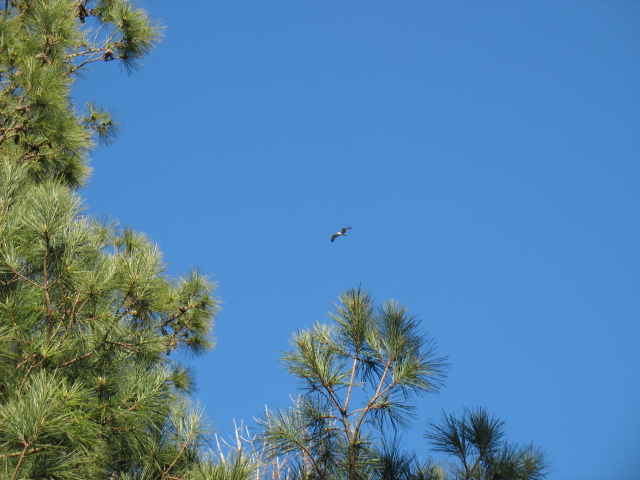
There is a good-sized pond about a quarter of a mile from here as the crow flies, or perhaps I should say as the osprey flies.  I was strolling around the yard as I'm wont to do on a Sunday afternoon, and I saw what I thought might have been a bald eagle.  After a minute I realized it had circled back.  (It seemed to be flying over the area of the power line that runs alongside the far side of my neighbor's property.)  I fetched my camera in hopes that I would get a third glimpse.
(This was the best shot.)
 
When I came back out with my camera, the first shot was quite distant even zoomed in, 
but then the bird obliged me by flying overhead.  I'm pretty sure it's an osprey.


Off into the wild blue yonder...


Saturday, March 18, 2017

Courting vultures

About a week and a half ago, I was outside snapping pictures when I saw a pair of black buzzards in a synchronized flight.  One vulture chased the other, and at one point they actually made contact in the air, though I didn't catch that part with the camera. 
We have turkey vultures and black vultures in these parts.  I see the turkey vultures more often.  Sometimes, in reference to Sheriff Andy Taylor prompting someone to call another person a "black-hearted buzzard," we will call the black vultures "black-hearted buzzards." 
Here are the pics in the sequence I took them.


Friday, March 10, 2017

Pruning my muscadines

I pruned my two muscadine vines yesterday.  Here is a set of "before and after" pics.  These vines were pruned last year, so even though they looked unkempt, that is just one year's worth of growth.


If you're looking for a "how to" tutorial, you might find this Ison's video helpful.  In my opinion, it is an excellent video.
This diagram from the Alabama Extension Service shows a little more clearly what is meant by pruning it back to "2 buds."  The extension service is saying 2 to 3 and Ison's says 1 to 2.  I think most of my cuts were to 3 buds.
(From this publication:  ANR-53-L, New June 1999. Arlie Powell, Extension Horticulturist, Professor, David Himelrick, Extension Horticulturist, Professor, William Dozier, Professor, and Dave Williams, Extension Horticulturist, Associate Professor, all in Horticulture at Auburn University)
 
 
I'm looking forward to this in the fall.
 
I may have to try a pie or something this year if I get a decent crop.  I came across a muscadine dreamcake recipe at a nursery this past year.  The pie looks divine, but I would probably alter it, using ingredients more readily available to me.
If you are deliberating about getting a muscadine, I highly recommend taking the plunge.


Monday, March 6, 2017

Nest building begins

Today I saw a warbler or some similar sized bird picking up a bit of white nesting material it had apparently dropped on the deck rail.  Just a few days ago, I had seen a mourning dove tugging at some dried grass by the sidewalk.  I had fully intended to clean the old nest out of the bluebird box by the end of February, but I had not.  (Daddy always says the road to hell is paved with good intentions.)  I thought I would observe a few minutes and go ahead and clean it out if the birds had not already built.  I saw the female taking nesting materials.  She had to wait while the mockingbird used the birdhouse for a perch.  I figured if she could wait for the mockingbird, I would take my turn as well.  I cleaned out the box, then put a few mealworms nearby to compensate for the extra energy needed to do some of the work twice.  The male bluebird was on lookout.  While the box was open and I had gone to fetch the whisk broom, he flew up to the top of the light pole where he often perches.

Then he flew to the nearby crepe myrtle to continue his surveillance.
 
After I had done closing the box back, he checked out the box itself as if to give the all clear.


Then the female checked it out as well.  She began bringing nesting materials again. 
 
If you look closely, you can see a dark spot near the center of the picture, just in front of the tall broom sedge.  It's the female bluebird gathering dried sedge or grass or straw.  (The other spot near the drive is a sparrow or junco foraging.)
 
At one point, she had nest materials to place while the male was inspecting the box.  Two or three times she fluttered in front of the box, waiting for him to move.  He finally went inside and she went in as well.  He soon flew out, and I could imagine her carefully arranging the straw in the nest.


Meanwhile back at the ranch, a white-throated sparrow was having a rather brisk bath.


There is lots of bird activity.  Spring can't be far behind.


Tuesday, February 28, 2017

Yellow-bellied sapsucker

I participated in the Great Backyard Bird Count again this year even though it is not nearly as enjoyable as it was when darling son was interested in doing it with me.
I relied on sound even when I wasn't able to spot the bird.  I did hear the yellow-bellied sapsucker, but I didn't count it because I wasn't sure which kind of woodpecker I was hearing.  A few days after the count, though, I saw the female yellow-bellied sapsucker on the sugar maple out front.  I enjoy watching a woodpecker.  According to the maps, the yellow-bellied sapsucker is a winter bird here in central NC and will be heading farther north for the summer breeding season.
(The colors really blend with the bark on the maple.)