Saturday, June 14, 2014

Trumpet creeper vine inspires passion

Did you ever have a love/hate relationship with a plant?  That's the way I feel about cow itch (trumpet creeper) vine.  When I moved onto this property, I judged the previous owners as being a bit slack for letting a cow itch vine grow up a pine.  I'm feeling a little more merciful towards them since I've been fighting that cow itch vine for 20 years, and it still is opportunistic enough to creep up that pine.  Just two weeks ago I broke the tine of my spading fork trying to dig up a cow itch vine.  Wretched vine!  I've rolled my eyes at advertisements for the vine in catalogues.  Sure it's pretty and attracts hummingbirds, but it is so reprehensibly aggressive!
But yesterday as I glanced out the kitchen window something scarlet caught my eye.  Now, I have white and cream flowers, pink and cerise flowers, purple and blue flowers, and yellow and orange flowers.  Very few, maybe one other that I can think of right now, of my flowers are SCARLET.  A touch of scarlet amongst a sea of green just excites, doesn't it.  It evokes impressions of some exotic tropical place.  Somehow a trumpet creeper vine had managed to sneak its way up the raintree, and, there at the end of the vine, suspended in midair, was a cluster of blooms!  It is pretty.  Here is a shot I took this morning.
Love or hate, that plant inspires passion.

Friday, June 13, 2014

Cooking sorghum--"there's a sleight to it"

Is there a special treat you associate with your grandmother?  For me, the special treat at Granny's house was a homemade biscuit (cooked in a woodstove) with sorghum molasses poured into the middle, the more, the better.  We just called it syrup or molasses.  "Granny, can I have a syrupy biscuit?"
I want to say Grandpa had cooking sorghum down to a science, but maybe I should say down to an art.  As a man whom my brother worked with years and years ago was wont to say, "there's a sleight to it."
Maybe experience was the best teacher, but experience had a talented man to work with in my Grandpa. 
About 13 years ago, I took my son and his friend on a field trip to see my aunt carrying on the tradition of cooking sorghum.
The first step is to cut the sorghum cane from the field.
 

Grandpa had made his own dedicated tool for this.  We call it a cane cutter.
 
Then the cane is unloaded and stacked where someone will strip the leaves from the stalk.  Shucking fodder we called it because the leaves could be fed to the cows.  Here are my grandparents shucking fodder.  There is a big barrel in the background which was used to collect the juice.
 
 
You can see my uncle in the background unloading the cane while my son and his friend take a taste of the raw cane piths.
 
Once the fodder has been stripped the seed heads are cut off. The seeds can be mixed in with cow feed.  Some seeds are saved to plant the following year.
 
In this picture you can see the piles of cane ready to be processed.  A couple of pieces of railroad track made a convenient place to stack the cane.  You can see a bridge in the background.  Grandpa had his cooking shed in the shade by the creek.  In the foreground you see the belt which goes from the tractor to the mill which crushes or "squeezes" the juice out of the cane.  It takes a lot of pressure to crush the cane stalks.  There is really not an efficient way to do it by hand.  Before tractors, folks would use mule power.  In some primitive cultures, men use a log to crush the juice out of sugar cane, but I wonder if they expend more calories than the end product provides.
 
After the cane is squeezed, the juice is strained and cooked.  Grandpa used the continuous flow method which entailed moving the juice through a maze in a huge shallow pan which sat atop a long, rectangular, wood-fired oven built of brick.
Last fall my brother and a colleague tried their hand at the process.  They used a lawn-mower-powered mill to squeeze the cane like the process seen HERE.
My son had grown quite a bit from his first field trip, but he still cut a piece of cane pith to chew on just like he did when he was a kid.
 
 
Here is the steam rising off the green juice in my brother's large open pan.  At this point it doesn't look particularly appetizing to me.  But it has a distinctive smell as it cooks that takes me back in time.
 
Here you can see the corner of the pan and the open end of the oven which is covered with a piece of metal.  The holes in the corners of the stainless steel pan accomodate staves which are used to lift the pan off the oven when the cooking is complete.  Grandpa's method did not require moving the pan; he just drew the cooked molasses into a container at the far end of the pan.  My brother has a dipper of the syrup to pour into the refractometer to test the sweetness.  That's one of them thar newfangled contraptions that Grandpa might not have even known existed.

 
Refractometers have all sorts of applications.  My brother's friend who is a nurse was familiar with the ones for testing the specific gravity of patient urine.  She always got the willies when she saw my brother doing a molasses taste test after taking the reading on the refractometer.
In this picture you can also see the custom made wooden paddle (poplar) lying flat across the pan (just under the dipper).  The paddle is used for the frequent stirring that is necessary in cooking the molasses.
My generous older brother gave me a jar from one of the batches.  I did not think it was up to par.  It was too green in color and flavor and too thick in consistency.  Mama said she liked the flavor after the syrup has aged a little.  My brother cooked a few more batches.  He gave Mama and Daddy some from one of the later batches.  When I saw it at Mama's and remarked on how good it was, she shared some with me.  Now this is right!  Golden brown, heady malty aroma, sweet and pourable.

 With real butter of course.  Yum.
There's just nothing like sorghum molasses.


Thursday, June 12, 2014

A political word or two

I don't anticipate blogging much about politics and foreign policy, but my post today is about that.  I've read the headlines yesterday and today and am dismayed to see what is going on with ISIS in Iraq.  I know men who served in Operation Iraqi Freedom.  It must be very disheartening to them to see what is happening. 
John McCain is calling for the resignation of the whole national security team.  After leaving a classified briefing by the Senate Armed Services Committee, McCain told reporters the "security situation in Iraq 'is the greatest threat since the Cold War.'"
I once read about some group sending a message to extraterrestrial aliens.  In case there are any aliens out there, this group wanted to let the aliens know we are friendly.  I just wanted to say, "Really?!"  We've pretty much been killing each other since Cain and Abel.  Any foreign policy that doesn't take that into account is just naive.
I think a lot of people I rub elbows with think of the Middle East as "over there."  I mostly do, myself, but I did have enough curiosity to look on the map and see that Syria and Iraq are next door neighbors.  Weren't we already issuing an ultimatum (and rescinding it) with Syria?  Supposedly the jihadists are bulldozing the berms which separate Iraq and Syria.  I think the US has a big foreign policy headache right now.


Wednesday, June 11, 2014

update to lightning bugs

Here is a lightning bug that somehow ended up inside the house just above the window screen.

Lightning bugs

A true summertime pleasure is relaxing in the evening and watching the lightning bugs.  They seem to be plentiful this year.  Monday I had a chance to sit on the front porch swing in twilight and watch them all across the front lawn.  In the (weedy) border at the edge of the lawn are two clumps of a wonderful daylily given to me by my generous older brother.  They make lovely yellow light in the border as the lightning bugs make their delightful greenish yellow light all across the lawn.
This is the daylily today.
 
Here are a couple of pictures that I took today of a lightning bug soldier beetle(?) in daylight on a Queen Anne's lace.
 
 
Okay, I'm updating this because just a little while ago, after I had adjusted the window and window screen, I somehow ended up with a lightning bug on my arm.  It blinked on and off and flew to the window screen.  I tried to get a picture.  It is blurry because neither the insect nor I could keep still.  But you can see enough to tell what it is.


Somehow watching a lightning bug evokes the delight and wonder of childhood.
They also remind me of Caleb's first piano recital.  The song he played was called "Firefly" and was a very simple little tune of mostly quarter notes and half notes.
 
A week or two ago I went out to look to for meteors.  The treetops in the back yard were full of lightning bugs.  They put on a much more dramatic show than the meteors.  I remember once when Caleb was small that we walked up the street in the evening.  There was one willow oak that was full of lightning bugs.  They set the whole tree twinkling like Christmas lights.
 
I think someday I would like to see synchronous fireflies like the ones in the Great Smoky Mountains.
 
Do lightning bugs bring back memories for you? 


Tuesday, June 10, 2014

The real Edith is magnolious!

One of my greatest pleasures over the last 20 years has been planting trees and shrubs.  Most of the plants I chose and planted myself with the help of my son.  One tree my husband wanted was a magnolia, so after studying the mail order descriptions, I went to a local nursery to pick out a magnolia.  I had read about the beauty of Magnolia grandiflora 'Edith Bogue,' and I got a chuckle to see her labeled as 'Edith Bogus.'  I declare she looked like the real thing to me.
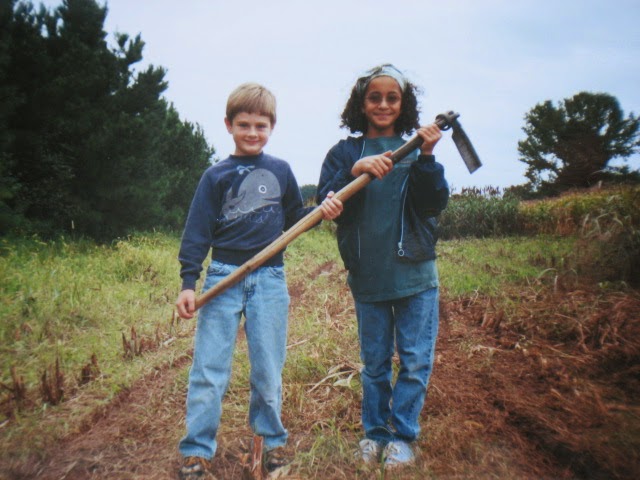
I had bought Caleb a little orange shovel for his own use even though he was not yet two years old.  Here he is with his dad, getting a hole dug for Miss Edith.  Caleb is twenty months old here, but he is keeping up with Daddy.


Here is Miss Edith in the background when Caleb was 15.  They had both grown considerably.


Now here's Miss Edith in her full blown glory.  My, how time flies.


Monday, June 9, 2014

Pollarding trees

I used to listen to a garden show on the radio which repeatedly warned against the ghastly practices of "crepe murder" and tree topping.  I don't prune back my crepe myrtles, and I admit, I might have adopted a bit of a snobbish attitude about leaving trees in a natural form.
However (you knew that was coming, didn't you), because of a personal dilemma, I've had to rethink this pruning and topping subject.  Of couse, my newfound knowledge of pollarding may enable me to once again be a snob. 
I have a sycamore tree that my generous older brother gave me to plant for quick shade when we moved to a house which had no shade trees.  My intent was to plant the sycamore for quick shade near the house, then cut it down when another, slower-growing tree a little farther from the house had time to get some size.  The sycamore turned out to be a good climbing tree, so I promised my son I would not cut it down before he turned 18.
 
 
As that milestone approached, my husband began to fret that I was intending to eliminate the only shade he had, so I needed to find a way to appease him for a while.
My generous older brother also happens to be quite knowledgeable about trees, and he let me know that cutting back sycamores is common in Europe where they call the sycamores plane trees and call the process pollarding.  I adapted the process to my situation and sent my dear son up the tree with a bow saw. 
 
 
He cut the top out.  The tree sure looked funny with a V-shaped gap in the top the next summer.  But the following winter, Caleb trimmed back some of the upper limbs to give it a little better shape.  This is what it looked like this past winter.  (You can also see pine limbs in the yard from three pines that were cut by professionals.  The tree with the cinnamon colored bark is an unmolested crepe myrtle.)  Click on the image to enlarge.


This is how the sycamore looks today.


If you want to see the professionals pollard a London plane tree, check out this time lapse video.  It is amazing to me.
If this topic has piqued your interest, you ought to do a web search of pollarded tree images.  You can see all kinds of trees with grotesque knobs that would give the "crepe murder" opponents heart attacks.